Why Did I Write This Note?
Every time we talk about artificial intelligence, we all think we're discussing the same thing. But the truth is that AI is like a prism. Everyone who looks at it from a different angle sees something different.
A software engineer thinks about model architecture. A philosopher asks "Can machines think?" An investor is only looking for profitable applications. In this note, I've tried to examine AI from several different angles—not to confuse you, but to give you a good mental map.
1. Level of Capability: From a Simple Assistant to a Digital God
This is the simplest way to categorize AI: What can it do?
Artificial Narrow Intelligence (ANI)
This is where we are now. Systems that excel at one specific task but know nothing else. For example, ChatGPT is a good poet, but if you ask it what time it is, it has no idea. Because it only knows text, not the "state" of the world.
Artificial General Intelligence (AGI)
This is the dream many are chasing. A machine that, like a human, can understand and do anything. For now, it's only in science fiction and research labs.
Artificial Super Intelligence (ASI)
Smarter than us. Much smarter. This is no longer a tool; it's an entity. People are still warning about it rather than trying to build it.
💡 In my opinion, the most important point is this
Many companies like to call their products "general intelligence," but they are really just advanced ANI. This classification gives us direction rather than showing us how to build.
2. The Construction Paradigm: How Do We Build Intelligence?
Here we're talking about the "method." What approach do we use to build AI?
Symbolic AI
The oldest method. Like mathematics or logic. We give the machine a set of rules and it decides based on them. For example, if we say "All humans die" and "Socrates is human," the machine concludes "Socrates dies." This method works well in law and rule-based medicine, but fails when faced with the complexity of the real world.
Machine Learning
This is where the revolution happened. Instead of writing rules, we give the machine lots of data and tell it to find patterns on its own. This method was much more successful because the world is full of exceptions and you can't write rules for everything.
Nature-Inspired Methods
Like evolutionary algorithms or swarm intelligence. Instead of imitating the brain, these take inspiration from nature—for example, from ant or bird behavior to find the best path.
Hybrid AI
The dominant approach today. Because we've realized that data alone is not enough. We need to combine logical rules with machine learning to get better results.
💡 My own note
Machine learning has taken over everything today, but we're only just realizing that for precision tasks, we still need that old logic.
3. Learning Methods: How Does the Machine Learn from Data?
Now that we've reached machine learning, let's see how many types of learning there are:
- Supervised Learning: Like a student practicing with an answer key. We show the machine thousands of cat images labeled "cat" so it learns. It's accurate, but labeling is expensive.
- Unsupervised Learning: We put the machine in a room full of different objects and tell it to group similar ones together. It discovers the pattern on its own.
- Self-Supervised Learning: The most exciting method today. The data itself generates questions for itself. For example, in language models, we ask the machine to predict the next word; the next word itself is the answer. This is the foundation of large models like GPT.
- Reinforcement Learning: Like training a dog. If it does the right thing, it gets a reward. This method works wonders in computer games and robotics.
- Continual Learning: The ability to learn gradually without forgetting previous knowledge. This is a major weakness of today's neural networks and many researchers are working on it.
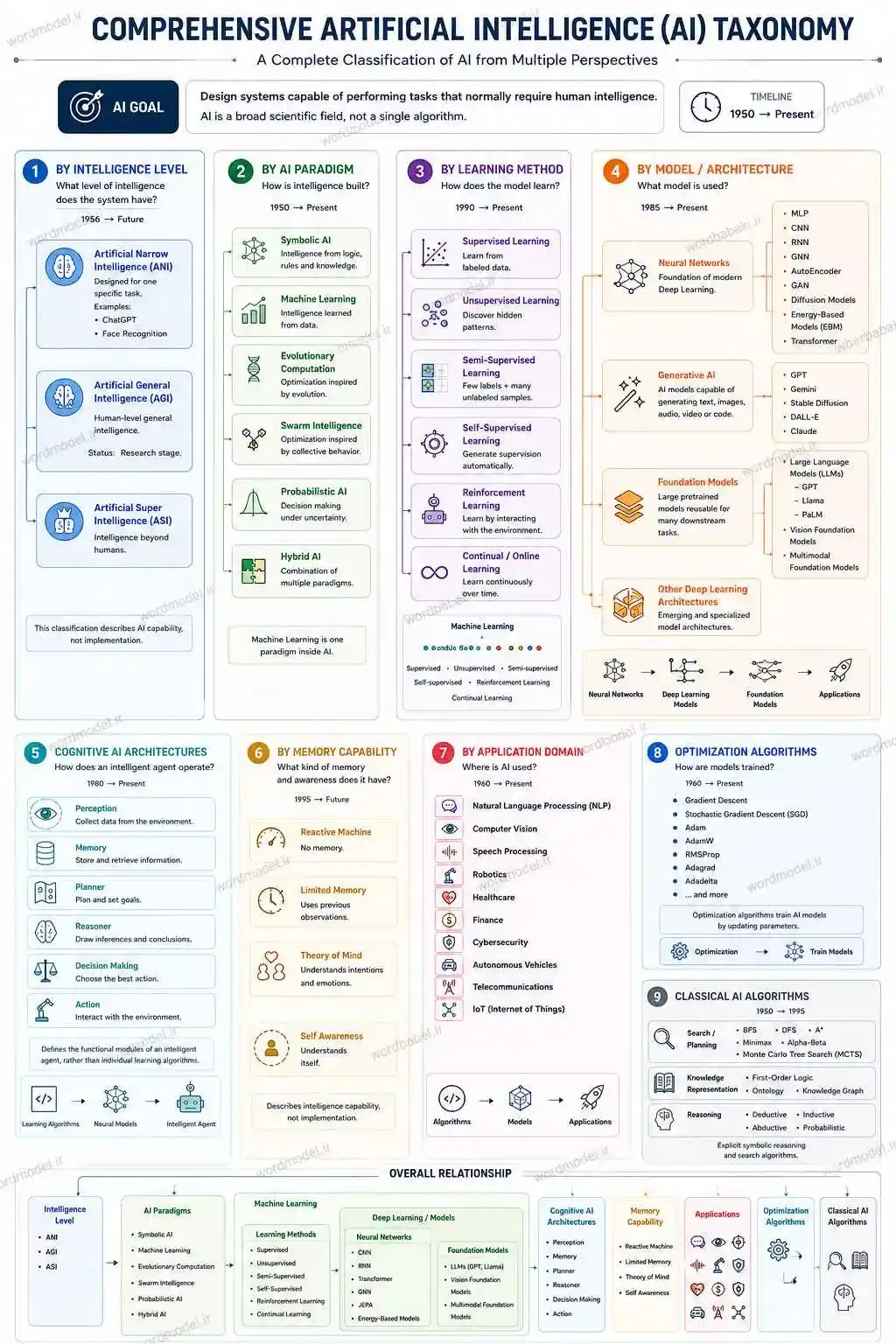
4. Model Architecture: What Is the Machine's Brain Made Of?
This section gets a bit technical, but I'll keep it simple:
- Classical Neural Networks: Like MLP for simple data, CNN for images, or RNN for text and audio. These were the early foundations.
- Transformer: This is the big breakthrough. An architecture that allows the model to look at all input words simultaneously and find relationships between them. All famous models today (GPT, Gemini, Llama) use this architecture.
- Generative AI: These create new content—text, images, audio, video. From old GANs and AutoEncoders to Diffusion models that have taken image quality to an incredible level.
- Foundation Models: The biggest strategic shift in recent years. A model trained on all possible data (like the entire internet) and then, with minimal changes, usable for thousands of different applications.
💡 An important point
Model architecture is different from learning method. Transformer is an architecture; you can train it with supervised or self-supervised learning.
5. Cognitive Architecture: How Does an Intelligent Agent Work?
If we only look at machines as neural networks, we miss a lot. Every intelligent agent (like a robot or virtual assistant) consists of several parts:
- Perception: Receiving information from the environment (text, image, sound).
- Memory: Storing previous information.
- Planner: Deciding on next steps.
- Reasoner: Drawing conclusions from information.
- Decision Maker: Choosing the best action.
- Action: Performing the action in the real world.
In this view, a language model like ChatGPT is only the "perception and reasoning" part. To become a real agent, it needs memory and a planner. This is why "Agentic AI" is such a hot topic these days.
For a deeper treatment of this perspective, see Yann LeCun's Autonomous Machine Intelligence Architecture .
6. Memory: From Simple Reaction to Self-Awareness
This classification tells me how much a system uses its past:
- Reactive Machine: Plays ping-pong but doesn't remember the previous hit.
- Limited Memory: Self-driving cars keep the last three seconds to avoid accidents.
- Theory of Mind: The machine understands what I know and what I don't. This is close to social understanding and has not yet matured.
- Self-Awareness: The machine is aware of its own existence. This is where we enter science fiction.
7. Applications: Where Is AI Used?
It's interesting that a single architecture (Transformer) has penetrated all these fields:
- Natural Language Processing (NLP): Chatbots, machine translation, customer sentiment analysis.
- Computer Vision (CV): Face recognition, reading signs, quality control in factories.
- Robotics and Self-Driving Cars: Where intelligence meets physics.
- Medicine and Pharmaceuticals: Like AlphaFold, which discovered protein structures and revolutionized biology.
- Security and Finance: Fraud detection in fractions of a second.
8. Optimization: The Engine Behind Learning
Without optimization, models learn nothing. This is pure mathematics. From simple algorithms like SGD to more advanced methods like Adam, which is today's gold standard. Choosing the right optimizer is sometimes more important than choosing the right architecture.
This also connects naturally to reasoning and gradient-based learning .
9. Classical AI: Roots That Should Not Be Forgotten
Before big data changed everything, AI was about search and logic:
- Search Algorithms: Like BFS, DFS, A*, and MCTS, which made champions in chess.
- Knowledge Representation: Like knowledge graphs and ontologies, still used in enterprise search engines.
- Reasoning: Induction, deduction, and inference, which are among the foundations of interpretability in today's models.
💡 I find it interesting that
These days we're returning to these methods because large models perform poorly in mathematics and multi-step logic, and we need to inject "classical logic" back in.
Conclusion: This Knowledge Tree Is My Roadmap
If you look at this article with a broad view, you'll see that no AI project works on just one branch of this tree. For example, to build a medical chatbot, you need:
- Use Machine Learning.
- Build the model with Self-Supervised Learning and Transformer architecture.
- Use Limited Memory and the Adam optimizer.
- And finally, inject logical rules (the old symbolic AI) to prevent major mistakes.
🎯 Final Word
AI is not a tool; it's a world. Each classification shows me a new angle. Understanding these dimensions is not an academic exercise for me, but a daily and strategic necessity. I hope this mental map is useful for you too.
Frequently Asked Questions About AI Dimensions and Classification
What are the main dimensions used to classify artificial intelligence?
AI can be examined from several perspectives, including capability levels such as ANI, AGI, and ASI; construction paradigms such as symbolic AI and machine learning; learning methods; model architecture; cognitive architecture; memory; applications; optimization; and classical AI.
What is the difference between ANI, AGI, and ASI?
ANI, or Artificial Narrow Intelligence, refers to systems designed for specific tasks. AGI refers to the idea of broadly capable intelligence comparable to human generality, while ASI refers to intelligence beyond human capabilities. These concepts classify systems primarily by capability level rather than by architecture or training method.
Is Transformer a learning method?
No. Transformer is a model architecture. Model architecture and learning method are different dimensions, and the same architecture can be trained using different learning approaches.
What is the difference between an AI construction paradigm and a learning method?
A construction paradigm describes a broader approach to building intelligent systems, such as symbolic AI, machine learning, or hybrid approaches. A learning method describes how a model learns from data or interaction, such as supervised, self-supervised, or reinforcement learning.
What role does cognitive architecture play in an intelligent agent?
Cognitive architecture describes functional components of an intelligent agent, such as perception, memory, planning, reasoning, decision-making, and action. This perspective considers the complete intelligent system rather than only its neural model.
Are memory and self-awareness the same thing in AI?
No. Having memory does not imply self-awareness. Memory concerns the use of information from the past, whereas self-awareness refers to the much stronger concept of a system being aware of its own existence and state.
Why does classical AI still matter?
Search, knowledge representation, and reasoning remain useful for certain problems. These approaches can also complement learning-based methods when systems need a combination of learned behavior and explicit logical structure.
Where do EBM and JEPA fit into this classification?
EBM and JEPA illustrate why capability level alone does not fully describe an AI system. Model architecture, internal representations, prediction, and learning objectives can provide additional dimensions. For a deeper discussion, see Energy-Based Models (EBM) and JEPA in Yann LeCun's Perspective .
What is a latent variable, and how does it relate to AI architecture?
A latent variable is related to how information or hidden structure is represented and modeled within a system. It therefore represents a different axis from classifications such as ANI or Transformer. This concept can be explored further through model architecture and World Model research.
Can one AI project belong to several categories at the same time?
Yes. This is one of the central ideas of this mental map. A system can simultaneously have a particular capability level, architecture, learning method, memory design, application domain, and optimization strategy, so no single classification is sufficient to describe the entire system.
For a deeper look at Energy-Based Models and their relationship to modern AI architectures, explore the related EBM and JEPA articles as well.
For a more cognitive and philosophical perspective, continue with The Cognitive Roots of Yann LeCun's View of Intelligence and World Models and Yann LeCun's Philosophy of Intelligence .
References & Further Reading
- Russell, S. J., & Norvig, P. (2021). Artificial Intelligence: A Modern Approach (4th ed.). Pearson.
- LeCun, Y., Bengio, Y., & Hinton, G. (2015). Deep learning. Nature, 521(7553), 436–444. https://doi.org/10.1038/nature14539
- Goodfellow, I., Bengio, Y., & Courville, A. (2016). Deep Learning. The MIT Press.
- Sutton, R. S., & Barto, A. G. (2018). Reinforcement Learning: An Introduction (2nd ed.). The MIT Press.
- Vaswani, A., Shazeer, N., Parmar, N., Uszkoreit, J., Jones, L., Gomez, A. N., Kaiser, Ł., & Polosukhin, I. (2017). Attention is all you need. In Advances in Neural Information Processing Systems (NeurIPS 2017).
- LeCun, Y. (2022). A path towards autonomous machine intelligence. OpenReview. https://openreview.net/pdf?id=BZ5a1r-kVsf