Introduction: From Cognitive Science to Engineering Intelligence
In his 2022 paper "A Path Towards Autonomous Machine Intelligence", Yann LeCun begins not with a purely engineering problem, but with a cognitive question:
"How did humans become beings that can predict, reason, plan, and understand the world?"
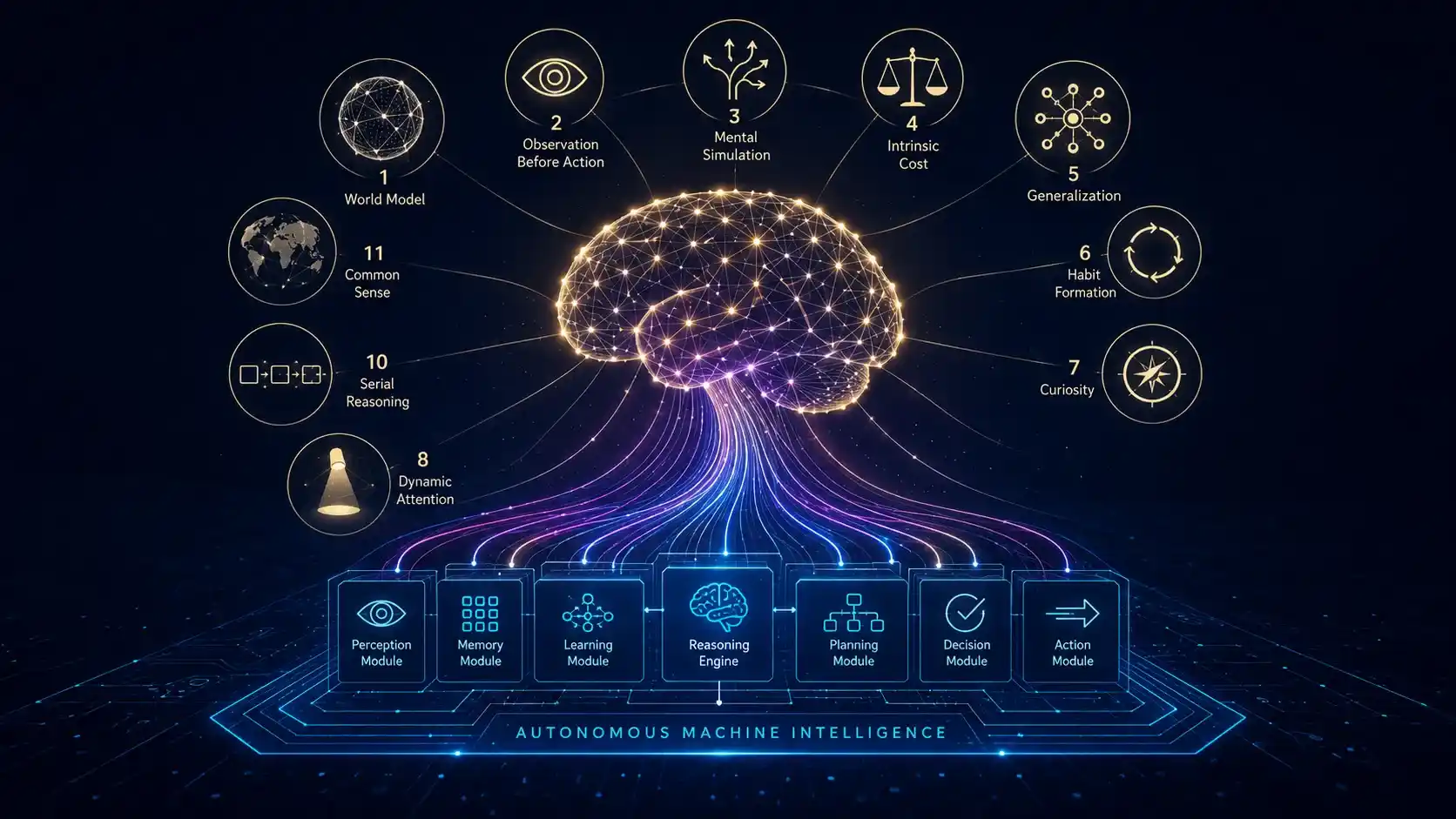
The answer to this question forms the philosophical core of his proposed architecture. Rather than designing an architecture entirely from scratch, LeCun draws inspiration from cognitive science and developmental psychology. In this article, I organize those ideas into eleven analytical principles in order to show how observations about natural cognition can be translated into architectural questions for autonomous machines.
For a more technical view of this progression, it is useful to read this article alongside Yann LeCun's autonomous intelligence architecture and LeCun's philosophy of World Models.
1. Learning the World, Not the Task
📌 Principle:
Humans do not start from scratch for every problem. They learn relatively general structures of the world and reuse that knowledge across different situations and tasks.
When a child repeatedly observes objects falling, they do not merely memorize the behavior of one particular object. They gradually build a mental model that enables prediction. They may not explicitly know the concept of "gravity," but they learn that released objects generally move downward.
LeCun connects this kind of general knowledge to Common Sense and the Mental Model of the World. The broader idea is that AI should not require a completely separate learning process for every task, but should instead acquire knowledge about the world that can be reused across tasks.
"How is it possible for an adolescent to learn to drive a car in about 20 hours of practice and for children to learn language with what amounts to a small exposure? How is it that most humans will know how to act in many situations they have never encountered?"
Architectural Implication: The focus shifts from purely task-specific learning toward representations and world knowledge that can support multiple tasks.
2. Primacy of Observation over Action
📌 Principle:
A large amount of human learning occurs through passive observation, and not every form of learning requires direct interaction.
Children spend hours watching objects move, people behave, and environments change. From LeCun's perspective, this makes it possible to acquire large amounts of knowledge without paying the cost of direct interaction for every example.
"Animals and humans learn enormous amounts simply by observing the world."
Architectural Implication: An intelligent agent should be able to learn from unlabeled observational data. This is where Self-Supervised Learning becomes an important tool for learning representations and World Models.
3. Mental Simulation of the Future
📌 Principle:
An intelligent agent can simulate possible consequences internally before executing an action in the real world.
If a ball is thrown toward you, your brain does not need to wait for impact before estimating its trajectory. If you want to cross a street, you consider the movement of cars before taking the step. Conceptually, this ability reduces the need for costly trial-and-error.
"They can predict the consequences of their actions, they can reason, plan, explore, and imagine new solutions to problems."
Architectural Implication: The World Model should be able to serve as a Predictive Simulator. In LeCun's architecture, it interacts with the Actor so that the possible consequences of proposed action sequences can be evaluated.
4. Decision Making Based on Cost, Not Just Reward
📌 Principle:
In LeCun's architecture, behavioral evaluation is not reduced to maximizing an external reward signal; Cost and Intrinsic Cost play central roles.
- If I cross the street, what cost or risk does it involve?
- If I rest today, what consequences might that create for tomorrow?
LeCun uses the concept of Intrinsic Cost to describe intrinsic costs. In the proposed architecture, Cost consists of two major parts: Intrinsic Cost, which is defined as immutable and non-trainable, and Critic, which predicts future intrinsic costs from experience.
"Scalar rewards provide low-information feedback to a learning system..."
Architectural Implication: Future outcomes are evaluated through a cost-based mechanism rather than solely through an external reward signal.
5. Generalizability of Experience
📌 Principle:
Humans extract more general concepts from specific experiences and reuse those concepts in new situations.
LeCun uses examples such as bicycles and motorcycles to illustrate this type of transfer. Once a person has learned the concept of balance on one vehicle, they do not need to learn the concept from scratch again on another related vehicle.
Architectural Implication: Representations learned by a World Model should be as Task-Agnostic and Generalizable as possible. This is closely related to the broader idea of Representation Learning.
6. Turning Thinking into Habit
📌 Principle:
Some behaviors initially require deliberate reasoning, but repetition can turn them into faster and more automatic behaviors.
Driving, typing, and many motor skills initially require attention and planning, but after sufficient practice much of their execution becomes automatic.
In LeCun's discussion, this idea can also be connected conceptually to the System 1 / System 2 distinction. This should be understood as an interpretive bridge between cognitive science and machine architecture rather than a formal equivalence.
Architectural Implication: One can conceptually connect World Model learning, planning, and the eventual development of faster policies for repeatedly encountered behaviors.
7. Intrinsic Curiosity
📌 Principle:
Intelligent behavior does not necessarily originate only from external reward; an agent can also have intrinsic drives and objectives.
In LeCun's architecture, this idea is connected to Intrinsic Cost. This part of the architecture is intended to represent intrinsic drives or basic costs; LeCun uses examples such as pain, pleasure, and hunger, while curiosity and exploration can also be motivated by intrinsic objectives.
"The Intrinsic Cost module is hard-wired (immutable, non-trainable)..."
Architectural Implication: The agent is not defined only by external reward; the architecture also includes an internal mechanism for valuation.
8. Dynamic Attention Regulation
📌 Principle:
What matters to an agent can change according to its current goal and task.
- If you are looking for your friend at an airport, human faces become important.
- If you are driving, traffic lights and nearby vehicles become more important.
Architectural Implication: This idea connects naturally to the Configurator in LeCun's architecture, whose role is to configure the other modules for the current task.
"Of all the least understood aspects of the current proposal, the configurator module is the most mysterious."
This distinction matters because the Configurator is not simply a conventional attention module. Its proposed role is broader: it configures other components of the architecture according to the task being performed.
9. Living in the World, Not Just Reading About It
📌 Principle:
Human knowledge is not built only from descriptions; perceptual and experiential interaction with the world contributes to the construction of internal models.
A child learns physical regularities not only by reading about them, but through observation, movement, touch, collisions, and everyday interaction with the environment. This is an important part of LeCun's argument about the limitations of relying on language alone.
Architectural Implication: A rich World Model should learn from observation and experience rather than depending solely on textual descriptions of the world.
This perspective is developed further in LeCun's philosophy of World Models.
10. Serial Attention
📌 Principle:
In LeCun's proposal, an agent with a single configurable World Model engine can focus on one complex task at a time while sharing the same underlying model and knowledge across tasks.
LeCun explicitly describes a single World Model "engine" that can be configured for the current task.
"The agent only possesses one world model 'engine'... Hence, similarly to humans, the agent can only focus on one complex task at a time."
Architectural Implication: A shared model can support knowledge reuse and transfer between tasks without requiring a completely independent World Model for each task.
11. Common Sense: The World Model Itself
📌 Principle:
In LeCun's view, Common Sense can be associated with a collection of World Models that help an agent reason about what is likely, plausible, or impossible.
"Common sense can be seen as a collection of models of the world that can tell an agent what is likely, what is plausible, and what is impossible."
When we see a glass near the edge of a table, we do not need to physically push it to predict that it may fall. Our internal model of the physical world allows us to make that prediction.
🧠 An Important Distinction
A language model can learn textual descriptions of the world. In LeCun's proposed direction, however, an autonomous agent should also develop an internal model of the world that can support prediction, reasoning, and planning.
Architectural Implication: One important goal of learning a World Model is the development of a form of Machine Common Sense that can support prediction and action in novel situations.
Conclusion: From Philosophy to Architecture
🎯 Eleven Principles Discussed in This Article
These eleven principles can be understood as an analytical framework for connecting the cognitive roots of LeCun's architecture across observation, learning, world modeling, prediction, attention, motivation, and decision-making.
Drawing inspiration from cognitive science, developmental psychology, and learning theories, LeCun proposes an architecture in which:
- The World Model learns from observation and predictive learning.
- The Actor uses the World Model to evaluate the consequences of possible actions.
- The Configurator adjusts the rest of the architecture for the current task.
- Cost, Intrinsic Cost, and Critic provide a mechanism for evaluating possible futures.
The deeper point is that the roots of this architecture cannot be reduced to a single deep-learning technique. The proposal is fundamentally about turning important features of natural cognition—building a model of the world, learning through observation, predicting the future, and evaluating the consequences of actions—into explicit architectural problems.
For the next step, see Yann LeCun's autonomous intelligence architecture and Latent Variables in LeCun's architecture to move from the cognitive foundations of the proposal to its technical components.
Frequently Asked Questions About the Cognitive Roots of LeCun's Architecture
Are the "eleven principles" an official list by Yann LeCun?
No. The eleven principles are an analytical organization used in this article to connect ideas discussed in LeCun's work. They should not be interpreted as an official numbered list published by LeCun himself.
What is the central cognitive idea behind LeCun's architecture?
One of the central ideas is that an intelligent agent should build an internal model of the world from observation and use that model to predict possible future states and the consequences of actions.
Why is observation important in LeCun's proposal?
Humans and animals can acquire large amounts of knowledge simply by observing the world. This motivates learning from observational data and emphasizes the role of self-supervised learning.
How is Common Sense related to the World Model?
In LeCun's framework, Common Sense can be viewed as related to collections of World Models that help an agent estimate what is likely, plausible, or impossible.
How is the Configurator connected to cognitive science?
The Configurator is a proposed architectural module that configures the other components for the current task. Comparing it with concepts such as Executive Control is an interpretive analogy rather than a formal equivalence stated by LeCun.
References & Further Reading
- LeCun, Y. (2022). A Path Towards Autonomous Machine Intelligence . OpenReview. https://openreview.net/pdf?id=BZ5a1r-kVsf
- Kahneman, D. (2011). Thinking, Fast and Slow . Farrar, Straus and Giroux.
- "The Existential Philosophy of LeCun's Approach to AI" - Related article on this blog
- "Yann LeCun: When a Pioneer Redraws the Roadmap of AI" - Related article on this blog
- "Yann LeCun's Autonomous Intelligence Architecture: From Reaction to Decision-Making" - Related article on this blog