Introduction: First Encounter with a Familiar Yet Unfamiliar Concept
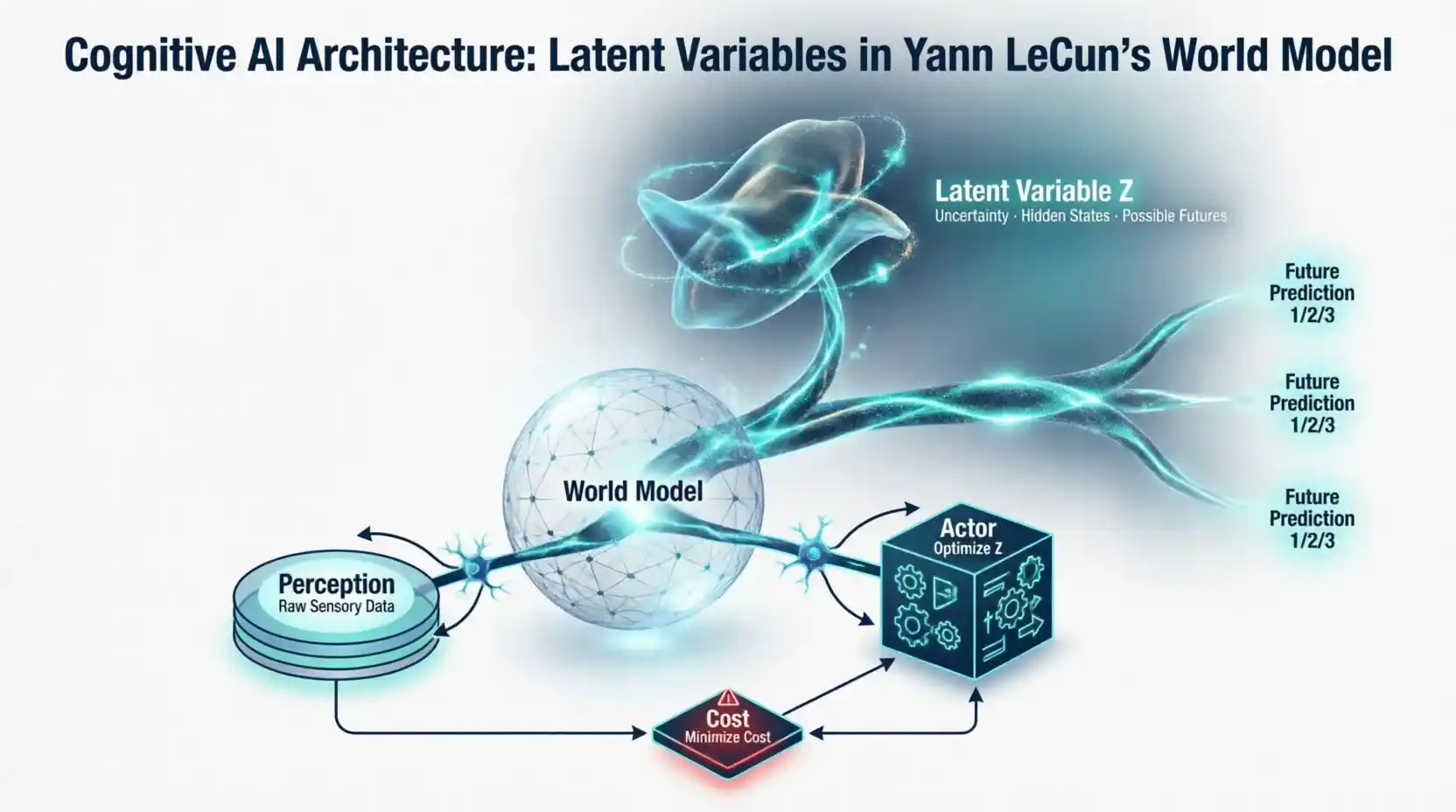
The first time I seriously encountered the concept of Latent Variable was in Yann LeCun's paper "A Path Towards Autonomous Machine Intelligence" (2022). What was interesting to me was not just the word "latent," but the position this concept found in LeCun's vision of an intelligent, autonomous machine. In this architecture, concepts like World Model, Energy-Based Model, Latent Variables, JEPA, Planning, and Uncertainty come together so that the machine can learn the world through observation, predict future states, imagine the consequences of its actions, and decide on actions accordingly.
LeCun himself emphasizes at the beginning of the paper that this is a position paper whose goal is to present a path and proposed architecture for building autonomous machines, not to introduce a final, complete algorithm.
To place this concept within the broader architecture, it is useful to read it alongside LeCun's autonomous intelligence architecture and the discussion of Energy-Based Models, because Latent Variable is not intended to be understood independently of World Models and energy-based formulations.
1. Initial Definition; What is Latent Variable?
At first glance, my understanding of the word "Latent" was very simple: something that is hidden and not directly observable.
For example, if I see an image of a car, the car itself is observable to me, but I cannot directly know what the driver will do next. Will they turn left? Go straight? Brake? So in an initial understanding, I can say that the "driver's intention" is a hidden factor.
But when I read LeCun's text more carefully, I realized that this definition of Latent is too limited. Latent here does not necessarily mean "a hidden object or truth in the world"; it can be a variable whose value is unobserved or not directly extractable from the input and is needed to explain the relationship between what we see and what we want to predict.
2. A More Precise Definition from LeCun's Perspective
In the "Latent-Variable Energy-Based Model" section, LeCun provides a definition that I find crucial for understanding the entire idea:
"The latent variable can be seen as parameterizing the set of possible relationships between an x and a set of compatible y."
And immediately adds:
"Latent variables represent information about y that cannot be extracted from x."
These two sentences changed my view of Latent. I no longer saw Latent merely as "hidden information," but as a variable for describing or parameterizing a set of possible relationships and states.
Mathematically, if we have:
Then a Latent Variable z can, conceptually, appear in the following relationship:
And z represents that part of the information about y that cannot be extracted from x.
3. Latent and Uncertainty; Representing Multiple Futures
From here, the first important connection between Latent and Uncertainty formed for me. The issue is not just that the machine doesn't know the correct answer; the issue is that the world itself can have multiple possible continuations.
In the "Handling Uncertainty with Latent Variables" section, LeCun explains that one of the main issues is the model's ability to represent multiple predictions, and that a latent variable can be used as one way to achieve this.
For example, suppose a car is approaching a fork in the road. If x is the image of the car at the current moment and y is the image of the same car a few seconds later, then:
Here, one current state, but several compatible futures.
LeCun further connects the concept of Latent to the part of the future that cannot be predicted from the past and current observation:
"The latent variable represents what cannot be predicted about y (the future) solely from x and from past observations (the past)."
And regarding the driver, he says:
"I may not know whether the driver in front of me will turn left or right, accelerate or brake, but I can represent those options by a latent variable."
4. Latent is Not Just a "Hidden Factor"
As I continued studying the paper, I realized that I shouldn't limit the concept of Latent to examples like "driver's intention."
In the paper by Dawid and LeCun titled "Introduction to Latent Variable Energy-Based Models: A Path Towards Autonomous Machine Intelligence" (published in the Journal of Statistical Mechanics, 2024), this concept is examined in more detail. They likewise describe a latent variable as a variable whose value is typically not given to us and which can capture information about y that is not directly available from x.
But the interesting point is that they don't introduce Latent only for Uncertainty. Latent can also be used for Structured Prediction—that is, when we don't know the structure of the data itself and the model must infer it.
For example:
- In Speech Recognition, we may have the audio but not the precise segmentation into words.
- In Handwriting Recognition, the segmentation of a word into letters may be unknown.
- In Image Understanding, some relevant structures, objects, or relationships may not be directly given to us.
Therefore, in these cases, the unknown structure of the problem can be modeled as a Latent Variable.
Key Point
Latent is not necessarily a "hidden reality"; it can be an unknown factor, state, structure, or variable needed to explain the problem.
5. The Main Challenge; Limiting Latent Capacity
A very important issue arises here: If Latent has too much capacity, the model may put all the information needed for prediction into z.
Dawid and LeCun give a very important warning here:
"The tricky part is that the information capacity of the latent variable must be minimized. Otherwise, the training may put all the information needed for the prediction into them."
This statement is very important to me. The goal is not to turn Latent into a massive memory. Rather, its capacity must be controlled so that:
- It can express the needed variation, uncertainty, or structure.
- But it doesn't store the entire problem within itself.
For this reason, the paper suggests that Latent capacity should be controlled through methods such as:
- Being Discrete
- Being Sparse
- Being Stochastic
- Being Low-dimensional
These mechanisms can be used to control the information capacity of the latent variable.
6. Difference Between Latent Variable and Latent Space
Here I find it necessary to distinguish between two concepts that are often seen together in many sources, but are not the same:
Latent Variable and Latent Space.
If we have:
Then sx is a Latent Representation of x. If we consider a set of these representations, we can speak of a space in which these representations reside:
This is commonly referred to as Latent Space or Representation Space.
But z in the discussion of Latent-Variable EBM is something else. z can be an unknown variable that the model must infer.
For me, this distinction is very important because in the discussion of World Model and JEPA, both concepts appear simultaneously.
7. Latent in World Model and JEPA Architecture
Now let's get to where Latent becomes part of a larger architecture.
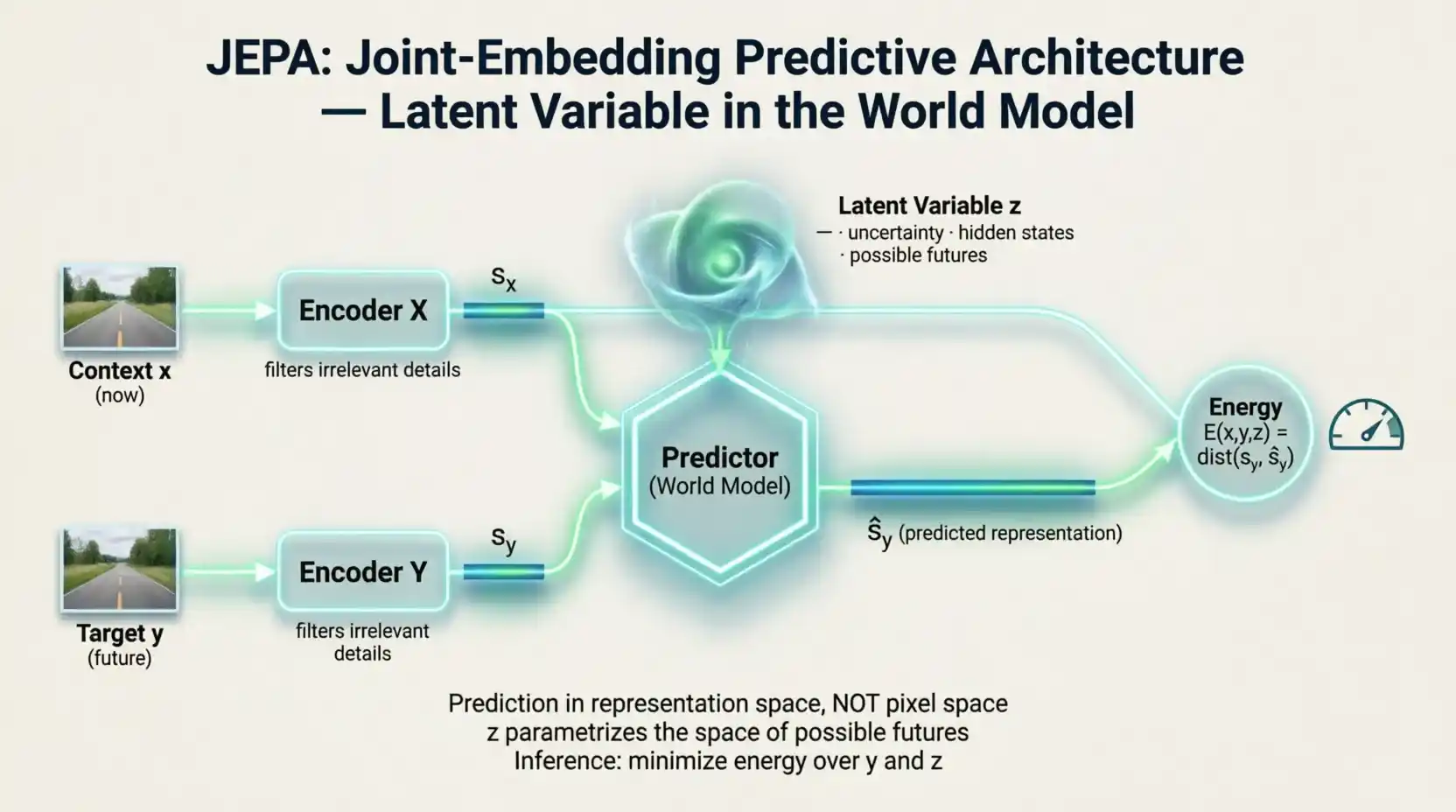
Here an important clarification is needed: the form below refers to the latent-variable framework discussed by LeCun and Dawid–LeCun. It does not mean that every architecture called JEPA necessarily contains exactly such a latent variable. For example, I-JEPA in the work of Assran et al. is a specific architecture for self-supervised learning from images, and it should not be identified wholesale with the latent-variable formulation discussed here.
For a broader view of this relationship, the article EBM, JEM and JEPA in Yann LeCun's proposed architecture provides additional context on the relationship between energy-based learning and predictive architectures.
In this framework, we have two representations:
And a predictor:
Where, in this formulation, z is a Latent Variable.
What is the role of z here? It can be used to model uncertainty and multiplicity in prediction—that is, situations in which sx alone does not uniquely determine sy.
As a result, z can represent relevant information about y that is not directly available from x and is needed to explain differences among possible predictions.
In this sense, a Latent Variable in this framework can allow the model to represent multiple possible predictions and thereby help handle uncertainty.
8. Latent in Service of Planning
One of the most fascinating applications of Latent is when it combines with Planning.
Suppose the agent wants to plan to achieve a goal. Conceptually, it can:
- Consider multiple possible futures using latent variables within the prediction model.
- Evaluate each future using a Cost Module or another evaluation mechanism.
- Select the appropriate path or action based on the evaluation.
To simplify this idea, we can write it conceptually as:
This formula is my conceptual formalization for explaining the relationship among prediction, latent variables, and planning; it is not a formula directly presented by LeCun or Dawid–LeCun.
In this formulation, zτ is a latent variable that can model variation or uncertainty in prediction.
Thus, Latent is not itself the decision-maker. Rather, it can play a role in modeling possible predictions, which can then be used in evaluation and Planning.
9. Conclusion; What Meaning Has Latent Found for Me?
After reading "A Path Towards Autonomous Machine Intelligence" and then "Introduction to Latent Variable Energy-Based Models", my understanding of Latent is no longer just "hidden variable."
But this variable can have different roles:
- It can be a Hidden Factor; like pose or a factor such as the driver's possible intention.
- It can be a Hidden Structure; like segmentation in speech or handwriting.
- It can be a Hidden Parameter; like the angle of a point on an ellipse.
- And in predictive architectures, it can be a variable that parameterizes variation among possible predictions or futures.
That is why Latent is connected to Uncertainty:
That is, one input can have multiple compatible predictions.
But there is a fundamental limitation:
Otherwise, the model may put all the information needed for prediction into z.
What is the goal?
Not to put "all the information in the world" inside Latent.
Rather, the goal is: Latent should contain enough information to explain important hidden factors, structures, and variations, but not so much capacity that the entire problem can be hidden inside it.
10. A Question That Remained for Me
Perhaps the most important question that remains for me after this discussion is no longer:
"What is Latent?"
But rather:
The Main Question
What should be preserved in a Latent Representation of the world, which factors should be modeled as Latent Variables, what information should not enter them, and how can these representations be used to imagine possible futures and choose an appropriate action?
In my view, it is precisely in answering this question that the classical concept of Latent Variable becomes connected to ideas such as Latent Space, World Model, JEPA, Uncertainty, and Planning, and in some proposed architectures for autonomous intelligence, becomes an important component of modeling and prediction rather than merely a statistical concept.
Frequently Asked Questions About Latent Variables
What is a Latent Variable?
A Latent Variable is a variable whose value is not directly observed or explicitly provided to the model and can be used to describe unknown factors, structures, or relationships between inputs and outputs.
What is the difference between a Latent Variable and a Latent Space?
A Latent Variable is an unknown variable or factor, whereas a Latent Space is the space in which latent representations reside. The concepts are related, but they are not interchangeable.
How are Latent Variables related to Uncertainty?
In some predictive frameworks, a Latent Variable can model variation among multiple compatible futures or predictions. This allows a model to represent more than one plausible continuation of a current state.
Why should Latent Variable capacity be limited?
If the latent variable has excessive information capacity, training may place much of the information needed for prediction inside the latent representation itself. Capacity control therefore helps preserve the intended role of the latent variable.
Does every JEPA architecture use a Latent Variable in this way?
No. The latent-variable formulation discussed here should not be equated with every JEPA architecture. I-JEPA, for example, is a specific architecture for self-supervised learning from images, while this article focuses on the latent-variable framework discussed by LeCun and Dawid–LeCun.
References & Further Reading
- LeCun, Y. (2022). A Path Towards Autonomous Machine Intelligence. OpenReview. https://openreview.net/pdf?id=BZ5a1r-kVsf
- Dawid, A., & LeCun, Y. (2024). Introduction to Latent Variable Energy-Based Models: A Path Towards Autonomous Machine Intelligence . Journal of Statistical Mechanics: Theory and Experiment, 2024, 104011. DOI: 10.1088/1742-5468/ad292b
- Ha, D., & Schmidhuber, J. (2018). World Models. arXiv preprint.
- Hafner, D., et al. (2019). Learning Latent Dynamics for Planning from Pixels. ICML.
- Hafner, D., et al. (2020). Dream to Control: Learning Behaviors by Latent Imagination. ICLR.
- Assran, M., et al. (2023). Self-Supervised Learning From Images With a Joint-Embedding Predictive Architecture . CVPR.
- Kingma, D. P., & Welling, M. (2014). Auto-Encoding Variational Bayes. ICLR.