Introduction
One of the questions that has always fascinated me in AI discussions is:
If we know humans can reason, why is building a machine that can genuinely reason like a human still so difficult?
In AI, we have very powerful tools for learning. Neural networks can learn patterns from vast amounts of data, make predictions, and achieve very strong performance on many problems.
But when it comes to Reasoning, planning, and problem-solving, the problem becomes different. We are dealing with something beyond pattern recognition. A system must be able to connect different states, account for constraints, and search among possible states or actions for one that is consistent with its goals.
This is where an interesting idea from Yann LeCun emerges:
LeCun's idea, paraphrased: Parts of reasoning may be formulated as a problem of energy minimization or constraint satisfaction.
This idea is part of LeCun's broader discussion of future AI architectures and appears in his work on Autonomous Machine Intelligence, World Models, and the role of the Actor in searching over possible actions and latent variables.
Two Different Perspectives on Reasoning
To understand this idea, we first need to distinguish between two approaches.
One approach defines reasoning in terms of rules and logic.
Example: Traveling from Tehran to Shiraz
We might say:
- If time is limited → take the airplane.
- If the budget is limited → take the bus.
- If the road is closed → choose another route.
- If there is enough time and cost matters → choose the cheaper option.
This perspective is close to Symbolic AI, where knowledge and reasoning can be represented using symbols, rules, and logical relationships.
But how does a neural network see the problem? In deep learning, the story is different. A neural network typically does not say, "If X happens, execute rule Y." Instead, it changes its parameters so that an objective function improves.
In differentiable models, this can be done using gradient information:
One simplified view of neural-network learning is therefore an optimization problem:
We no longer need to write an explicit rule for every behavior. The model searches for parameters that optimize the objective function.
The Intersection of These Two Worlds
On one side, reasoning is often discussed in terms such as Rule → Constraint → Logic → Planning. On the other side, deep learning primarily works with Loss → Gradient → Optimization.
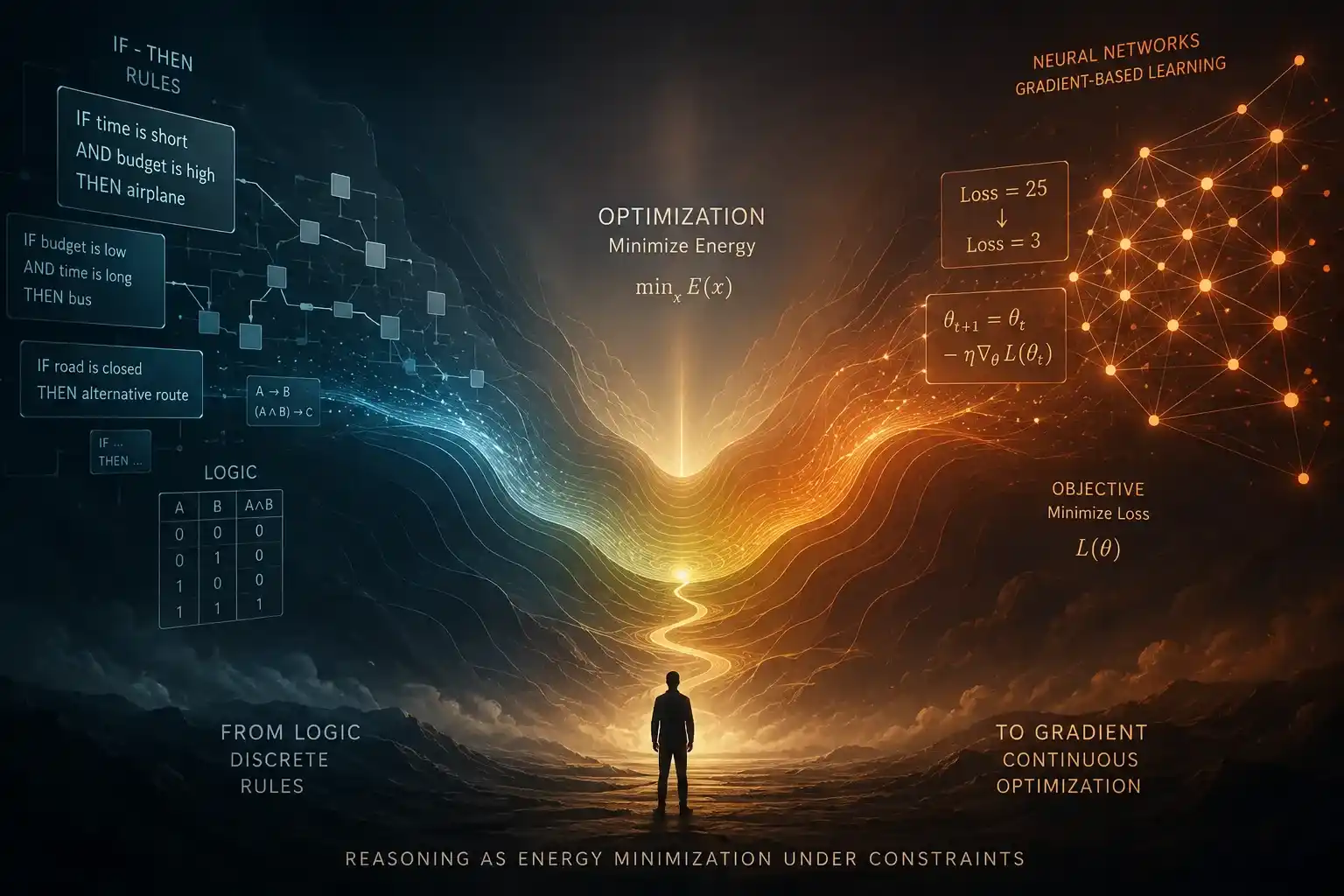
A natural question therefore arises:
Can a problem that appears logical and discrete be transformed into an optimization or constraint-satisfaction problem?
This is where Energy-Based Models and the energy-based view become especially interesting.
Instead of directly saying "this state is correct and that state is incorrect," we can assign an energy value to each state. Desirable states have lower energy, while undesirable states have higher energy.
In other words: find the state with minimum energy.
A Simple Example: Sudoku
To make the idea more concrete, Sudoku is a useful example.
In the classical approach, we define the problem through a set of rules:
- No repeated numbers in a row.
- No repeated numbers in a column.
- No repeated numbers in a 3×3 block.
These are Constraints.
Instead of directly declaring a state "valid" or "invalid," suppose we define a cost for violating each constraint:
If a candidate solution violates two rules:
If no rule is violated:
Solving the problem can therefore be expressed as:
In the ideal case:
Meaning that all constraints are satisfied.
Is This Really Reasoning?
We need to be careful here. This example alone does not mean that the full problem of Human Reasoning has been solved.
Sudoku is a limited and highly structured problem whose constraints can be defined in advance. Turning those constraints into a cost or energy function is therefore relatively straightforward.
The more important idea is:
If parts of reasoning can be represented as a cost, energy function, or set of constraints, then the search for a solution may be placed within an optimization or constraint-satisfaction framework.
Instead of forcing a system to explicitly execute a sequence of discrete rules, we can define a space of possible states and guide the search toward states that are more consistent with the problem's constraints and goals.
From "True or False" to "Low-Energy or High-Energy"
In classical logic, we might say:
- This state is valid.
- Or: this state is invalid.
In an energy-based view, we can instead say:
- This state is more consistent with the constraints and has lower energy.
- The other state has higher energy because it violates more constraints.
Why Is This Idea Important for Deep Learning?
This brings us back to the central issue of neural networks.
One of the major strengths of Deep Learning is that Gradient-Based Optimization provides a powerful framework for learning model parameters.
A model can define an objective, compute gradient information, and adjust its parameters in a direction that reduces the Loss.
So if parts of a reasoning problem can also be expressed as an optimizable function or constraint-satisfaction problem, an interesting possibility emerges:
Reasoning can, in some cases, be brought into the form of a search problem over states, actions, and latent variables that may be solved through optimization.
⚠️ An Important Distinction
This does not mean: "Reasoning = Gradient Descent"
In LeCun's framework, if the variables being searched are continuous and the Predictor and Cost modules are differentiable and sufficiently well behaved, gradient-based methods can be used for the search. But when the action space is discrete or strongly discontinuous, other methods such as exhaustive search, heuristic search, or Monte-Carlo Tree Search may be more appropriate.
The core idea is therefore not to equate reasoning with gradients, but to formulate parts of reasoning in a form where systematic search, energy minimization, or constraint satisfaction becomes possible.
Conclusion
The idea of transforming reasoning into an optimization problem is one of the most interesting aspects of Yann LeCun's broader view of future AI architectures. The important point is that reasoning does not necessarily have to be understood only as the explicit execution of symbolic rules. Some forms of reasoning may instead be represented as the search for a state or sequence of actions that is consistent with a set of constraints and goals.
In this framework, Energy-Based Models, World Models, latent variables, and search over possible actions can be connected. When the search space is suitable, gradient-based optimization may provide an efficient search mechanism; however, it is not the only possible mechanism, and discrete or discontinuous spaces may require different search strategies.
🎯 The Core Idea in One Sentence
Instead of always defining reasoning as the explicit execution of rules, some reasoning problems can be represented as a space of possible states and constraints and then formulated as an optimization problem over a cost or energy function.